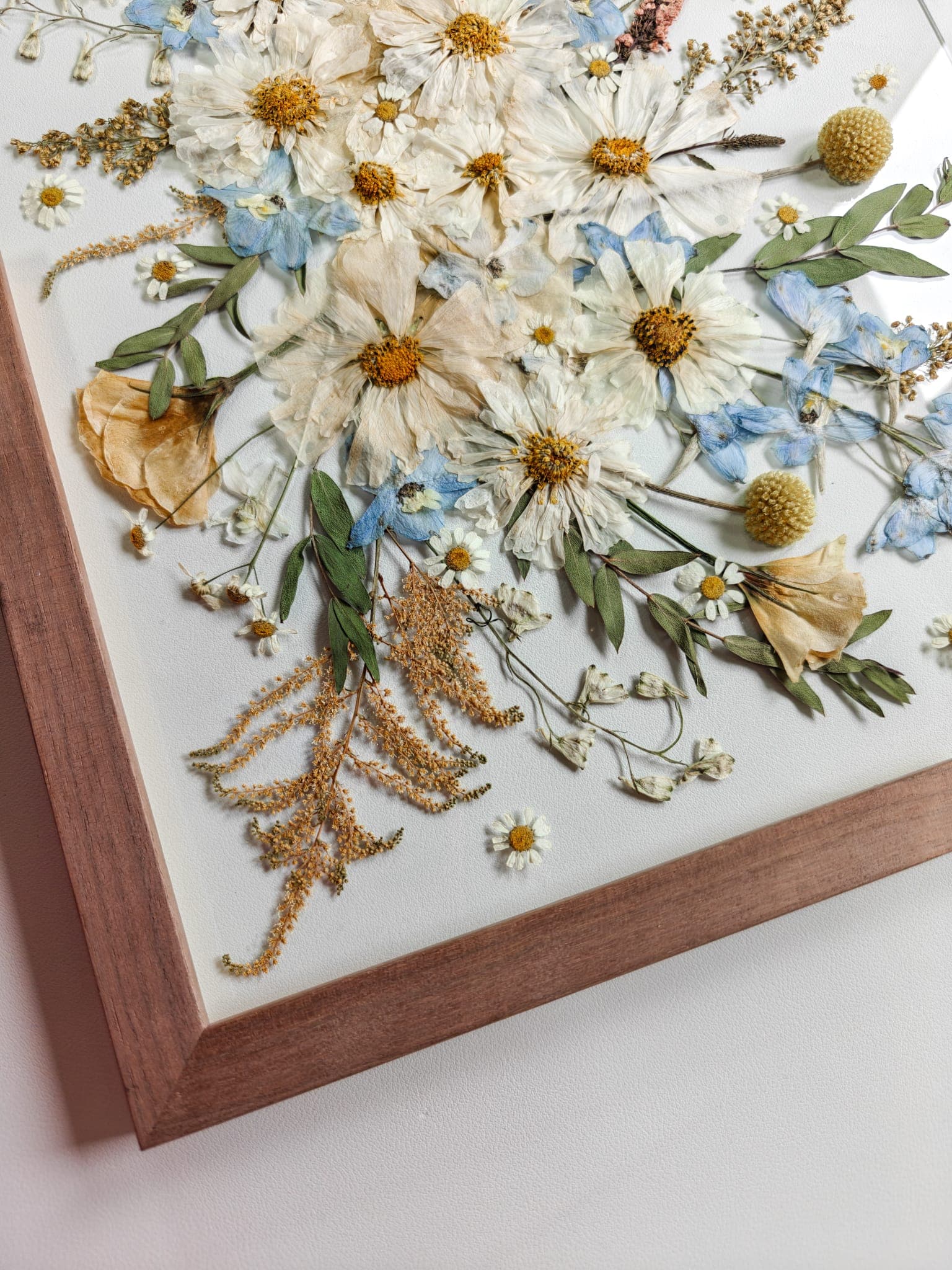
The wedding is over, the house still smells like a party, and on the table sits your bouquet. Throwing it away feels unthinkable, but it is wilting by the day. Now what?
This is probably the message we receive most often from brides after the big day. The good news: there are several options, and almost all of them are still available in the first few days. Let's go through them, with honest pros and cons.
First, the urgent part: the mistake to avoid
Before deciding what to do, avoid the one mistake that eliminates every option: leaving the bouquet out of water, in the sun, or inside a car.
As soon as you can, trim the stems slightly, place the bouquet in a vase with clean water and keep it in the coolest room of the house, away from direct light (and out of the fridge). Change the water daily. With this simple care, most bouquets stay in good condition for the first days, more than enough time to decide calmly.
1. Air drying (upside down)
The classic method: hanging the bouquet upside down in a dry, dark place for 2 to 4 weeks.
Pros: free, simple, keeps the three-dimensional shape. Cons: colours darken considerably, petals become brittle and collect dust, and the piece visibly degrades within a few years. It works best with roses and sturdy flowers; delicate ones fall apart.
2. Silica gel
Burying the flowers in silica crystals for one to two weeks removes moisture while preserving colour better than air drying.
Pros: truer colours, good for individual flowers. Cons: requires practice and materials, petals break easily when unearthed, and the result remains fragile and sensitive to humidity. It also doesn't solve the "where do I keep this now?" question.
3. Pressing at home
The herbarium method: flowers between absorbent paper, under heavy books, for weeks.
Pros: free, lovely for simple flowers (pansies, daisies). Cons: flowers with volume (roses, peonies) develop brown spots and lose colour unless they are deconstructed and pressed petal by petal with humidity control. That is exactly where the home version tends to go wrong.
4. Epoxy resin
Resin blocks and shapes with flowers inside have become popular on social media.
Pros: modern look, three-dimensional format. Cons: resin can yellow over the years and the process is irreversible. We compared both methods in detail in resin or botanical pressing.
5. Giving the flowers away
Donating the bouquet (or the remaining wedding flowers) to a care home, hospital or church is a beautiful gesture when you don't want to keep anything physical.
Pros: the flowers make someone happy a second time. Cons: no physical memory of the bouquet remains.
6. Keeping just a few elements
A ribbon, a dried flower inside a book, a bow in the photo album. Minimalist and free.
Pros: simple, fits in any drawer. Cons: over time, a loose flower forgotten in a book rarely survives well.
7. Professional preservation in a frame
This is what we do at our studio in Coimbra: the flowers are deconstructed, pressed individually with humidity control, recomposed into a design you approve, and framed with a custom-made surround, with the option of anti-UV museum glass.
Pros: colours and shapes hold for decades, the result is a piece of art ready to hang, and you follow the whole process online. Cons: it has a cost (from €300) and takes a few months, because pressing cannot be rushed.
If you want to figure out whether it makes sense for you, we wrote an honest reflection in is it worth preserving your wedding bouquet?
"But my wedding has already happened!"
If you are reading this with the bouquet already at home, breathe: in most cases there is still time. With the flowers in water and somewhere cool, we can usually preserve them as long as they reach us within the first 6 days after the event. Not near Coimbra? Follow our guide to shipping your flowers by post, it was written exactly for this moment.
And if too much time has passed? There is a solution too: we recreate the bouquet with similar fresh flowers, from a photograph.
The most important thing is not to rush the decision alone: talk to us, we will assess the condition of the flowers and tell you frankly what is possible.